
Every sales leader wants predictable growth and that’s hardly surprising.
We set targets, invest in tools, refine territories, and roll out training programs with the best of intentions. Yet year after year, many sales teams still fall short of quota. It is not that they lack effort, but often effort alone doesn’t translate into performance.
As per a Salesforce study, 84% of sales reps missed their quota last year. It’s important to know that simply telling people what to do is not the same as enabling them to do it well.
This is where an important distinction often gets blurred: sales training versus sales coaching. The two are frequently used interchangeably, but they serve very different purposes. Understanding that difference, and more importantly, designing for both, is one of the most critical responsibilities of modern revenue leadership.
How is Sales Training Different from Sales Coaching
To build consistent sales performance, leaders must clearly distinguish between what sales training delivers and what sales coaching actually develops.
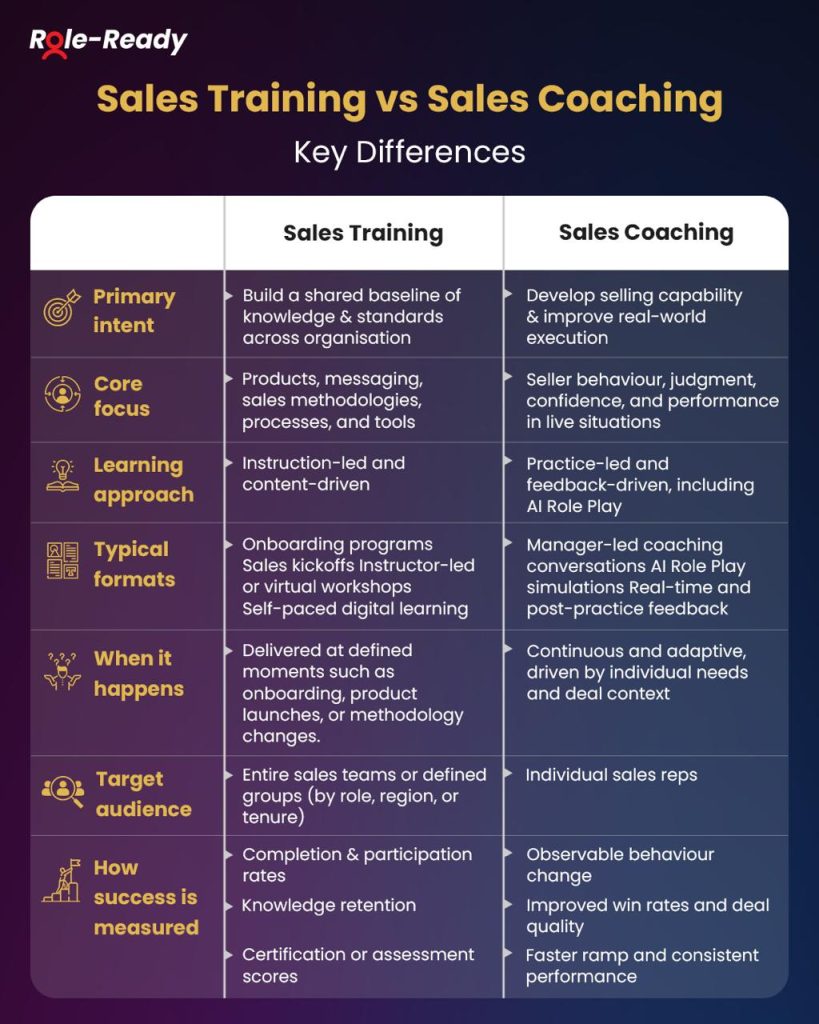
Here’s an overview of some key differences between the two:
1. Knowledge Vs capability
Sales training is designed to create alignment and shared understanding. It introduces sellers to the organization’s products, messaging, sales methodology, tools, and processes. Training ensures consistency and clarity, especially important in growing teams where standardization matters.
Typical sales training focuses on:
- Product and solution knowledge
- Sales frameworks and methodologies
- Internal processes, tools, and compliance
- Messaging and positioning
Sales coaching, however, serves a different purpose.
Coaching is not about introducing new information. It is about helping sellers apply what they already know in real situations. It focuses on behavior, judgment, and execution.
Good sales coaching helps reps:
- Translate knowledge into live conversations
- Adapt messaging based on buyer responses
- Strengthen decision-making under pressure
- Build confidence through repetition and feedback
Training tells sellers what ‘good’ looks like. Coaching helps them be good consistently.
2. Event-based learning vs continuous development
Sales training is typically delivered in structured formats and at defined moments.
Onboarding programs, quarterly enablement sessions, product launch trainings, and methodology refreshers are all examples of training tied to organizational change. This model works well for distributing knowledge at scale.
Common sales training formats include:
- Instructor-led workshops
- Virtual training sessions
- Video modules and assessments
- Self-paced, on-demand learning
Sales coaching, by contrast, must be continuous to be effective.
Selling happens every day, often in unpredictable situations. Coaching cannot be confined to scheduled meetings alone. It needs to show up when reps are preparing for key conversations, reflecting on difficult calls, or practising new approaches.
Modern sales organizations are increasingly using AI-enabled Role Play to support this need. AI allows sales teams to practise and receive feedback between meetings, without waiting for manager availability.
This shift moves coaching closer to the work itself, where learning has the greatest impact.
3. One-to-many vs one-to-one
Sales training is usually built for scale. Enablement or learning teams design training programs for broad audiences including entire sales teams or segments based on role, region, or tenure. The goal is efficiency and consistency.
Sales coaching, however, is inherently personal. Each salesperson has different strengths, gaps, and deal contexts. Effective coaching reflects that reality. Historically, direct managers have carried primary responsibility for coaching, tailoring guidance based on observed performance.
But as teams grow and manager spans widen, this model becomes difficult to sustain. Even the best managers struggle to deliver consistent, high-quality coaching at scale.
4. Content delivery vs experiential learning
Sales training and sales coaching rely on different types of tools, though overlap is increasing.
Training is typically supported by:
- Learning management systems (LMS)
- Content libraries and playbooks
- Video and assessment platforms
These tools are effective for distributing information and tracking completion.
Sales coaching requires tools that surface behavior, not just knowledge.
Coaching is supported by:
- CRM and deal review systems
- Conversation intelligence tools
- Live or simulated role-play environments
- Feedback and performance analytics
Increasingly, organizations are integrating these capabilities to create cohesive enablement ecosystems. The focus is on experiential learning, giving sales reps realistic environments to practise conversations, make decisions, and receive immediate feedback. This bridges the gap between knowing and doing.
5. Activity metrics vs performance impact
Sales training is often measured through participation and completion metrics.
Common indicators include:
- Course completion rates
- Assessment scores
- Certifications achieved
While useful, these metrics say little about whether training changed behavior.
Sales coaching metrics have traditionally focused on activity like number of coaching sessions, frequency of manager check-ins etc. But activity alone doesn’t guarantee effectiveness.
What matters most is whether training and coaching lead to:
- Stronger selling behaviors
- Greater confidence in conversations
- Improved win rates and deal quality
- Faster ramp and sustained performance
This requires tying enablement efforts to real-world execution, not just learning activity.
How Sales Training vs Sales Coaching is not an Either–or Decision
B2B selling is complex by default. Longer sales cycles, multiple stakeholders, and high-value decisions demand adaptability and judgment. Sales people must navigate ambiguity, tailor messages, and respond confidently to pushback. In this environment, knowledge alone is insufficient.
Which is why high-performing sales organizations don’t choose between training and coaching. They design for both. Sales training lays the foundation. Sales coaching builds on it. Together, they create a continuous learning loop, introducing concepts, reinforcing application, and refining execution.
Without training, sales reps lack direction. Without coaching, training remains theoretical.
When sales training and coaching work together, organizations benefit from:
- Faster onboarding and ramp-up
- Higher win rates driven by better conversations
- Greater resilience during market or product change
- Stronger engagement and retention among top performers
How AI Role Play is Reshaping Sales Training and Sales Coaching
Traditional sales training and coaching models were never designed for scale. They rely heavily on manager availability, scheduled sessions, and one-size-fits-all content which makes consistency and timeliness difficult to sustain as teams grow.
AI Role Play changes this dynamic by shifting learning from instruction to experience. Instead of consuming content, sales reps actively practise the conversations that define success in their role.
AI Role Play enables:
- Personalized skill development, where scenarios adapt to individual roles, regions, and performance gaps
- Realistic conversation simulations, reflecting real buyer behaviour, objections, and decision-making patterns
- Immediate, objective feedback, covering language, tone, structure, and confidence, right after each interaction
Most importantly, AI Role Play addresses what many enablement strategies miss: the last mile between learning and performance.
By allowing sales reps to rehearse high-stakes conversations repeatedly in a safe environment, AI Role Play builds confidence through doing, not memorising. Practice happens in the flow of work, without the pressure of live deals or the dependency on manager-led sessions.
As a result, sales coaching shifts from being an occasional intervention to a continuous habit, embedded into everyday work and directly connected to real performance outcomes.
Final Thought
The challenge for sales leaders is not choosing between sales training and sales coaching. It is ensuring the two are connected through meaningful practice.
While training builds understanding, coaching builds capability and practice builds confidence.
Platforms like Role Ready are designed to close this gap by bringing Agentic AI role play into the daily flow of work. Instead of relying only on scheduled sessions or manager availability, reps practise real conversations through realistic simulations—handling objections, navigating pushback, and making decisions as they would in live deals. Immediate feedback on pitch, language, tone, and structure helps them reflect, adjust, and improve in the moment.
When learning moves beyond content and into experience, supported by last-mile coaching in the flow of work, performance becomes less dependent on individual brilliance and more on a system that consistently builds role-ready sellers.
To learn more about what Role Ready can do for your sales teams,
FAQs
1. Can sales coaching replace sales training?
No. Sales coaching cannot replace sales training, and sales training cannot replace sales coaching. Training provides the foundational knowledge—products, processes, messaging, and methodology—that sellers need to operate with clarity and consistency. Coaching builds on that foundation by helping sellers apply what they know in real conversations. Without training, coaching lacks direction. Without coaching, training remains theoretical. High-performing sales teams design for both.
2. Why do sales teams struggle to scale effective coaching?
Traditional sales coaching depends heavily on manager availability and scheduled interactions, which makes consistency difficult as teams grow. Managers often oversee larger teams and carry multiple responsibilities, limiting the time they can spend on skill-level coaching. As a result, coaching becomes reactive and uneven. This is why many organisations are turning to AI Role Play to provide sellers with realistic practice and immediate feedback—without increasing the burden on frontline managers.
3. How does AI Role Play improve sales performance beyond traditional enablement tools?
AI Role Play moves sales enablement from content consumption to experiential learning. Instead of only learning what to say, sellers practise how to say it in realistic scenarios—handling objections, navigating pushback, and adapting in real time. Immediate, objective feedback on tone, language, structure, and confidence helps sellers improve through repetition. This last-mile coaching closes the gap between learning and performance, making skill development continuous and measurable.